Understanding Certificate Of Evaluation For Peptide Sourcing Gabriel Alizaidy, Md, Ms Published On The Subject
Despite a totally legitimate peptide CoA, inadequate handling can modify the framework. That's why we constantly suggest maintaining referral materials in proper storage immediately. For instance, if a pollutant is listed, laboratories will certainly verify the limitations to see if it's normal for that kind of peptide. They might additionally want to know just how to discover the day when the example was examined, considering that older tests sometimes require more checks. Reading a CoA isn't about remembering every term yet knowing what each number suggests for the task.
- Oftentimes, self-confidence comes from the overall pattern, not from one record alone.All items are cost research, research laboratory, or logical objectives only, and are not for human intake.A batch-specific record is a lot more valuable than a common data that shows up reusable throughout numerous listings.Explore the usual research laboratory methods made use of to analyze peptides in research settings.Each Certificate of Evaluation goes through an extensive examination process to validate product stability.
Search, Preview & Download Research Peptide Coas

Questions Buyers Ought To Ask Prior To Relying On A Coa
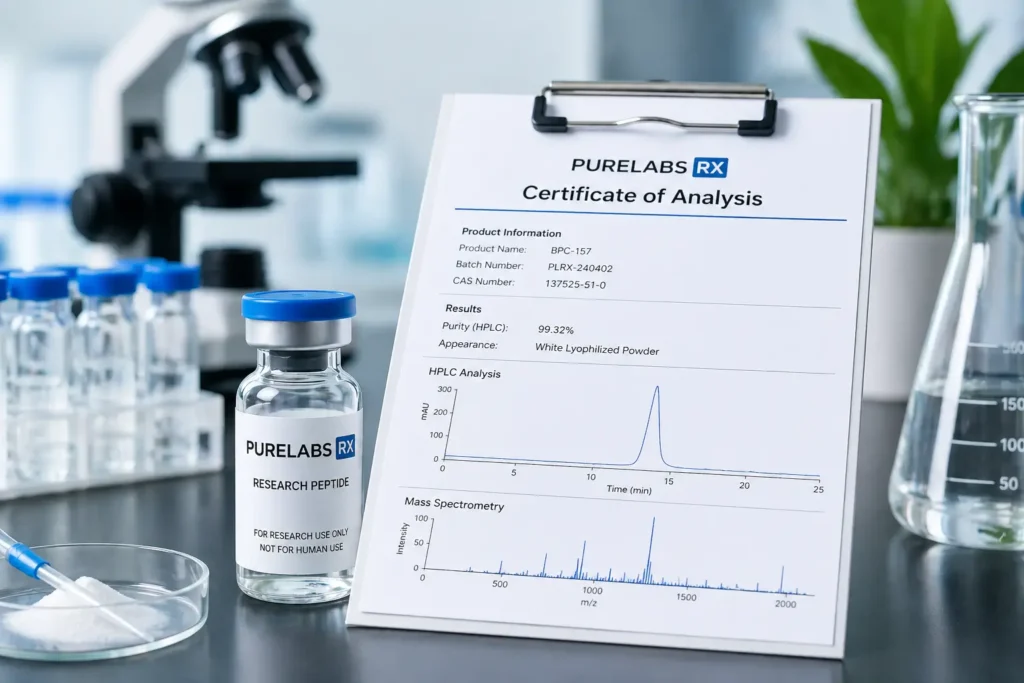
A peptide certificate of evaluation is a logical report created by a laboratory after a compound has actually undertaken testing. The record summarizes the outcomes of laboratory analysis executed on a particular set of a peptide research study substance. HPLC can give useful purity-related information, however it does not always completely verify peptide identity on its own. That is why buyers often look for added sustaining techniques, such as LC-MS, when evaluating peptide documents.Nonetheless, recognize that labs do update their reporting formats occasionally. Verifying COA authenticity calls for systematic cross-referencing and, when possible, independent verification. Begin by confirming the testing research laboratory exists and preserves current accreditation. The fundamental function of a COA prolongs past simple regulatory compliance. It gives proven evidence that the peptide you get suits what was ordered, includes the stated purity level, and is devoid of dangerous pollutants. If the COA includes very limited method info, uncertain screening recommendations, or obscure research laboratory information, it becomes tougher to assess the logical context behind the result.To make sure top quality, each batch undergoes extensive testing to satisfy rigorous sector standards. Additionally, we provide a Certificate of Evaluation (COA) for every single product to guarantee transparency. This essential record verifies identity, pureness, and structure, making certain researchers get trustworthy compounds for their researches. Grasping COA analysis represents a vital ability for any individual entailed with study peptides. The paper serves as your key quality control tool in a market where governing oversight remains minimal and item top quality differs drastically in between providers.
Matrix-Assisted Laser Desorption/Ionization Time-of-Flight (MALDI-TOF) and Electrospray Ionization (ESI) represent both main mass spectrometry techniques utilized for peptide evaluation. Both techniques ionize the peptide particles and determine their mass-to-charge ratio, creating a range that serves as a molecular fingerprint. Some COAs include the real chromatogram photo, which provides aesthetic confirmation of pureness insurance claims.